The Password Is Animal Style: How Off-Menu Orders Became America's Cheapest Status Symbol
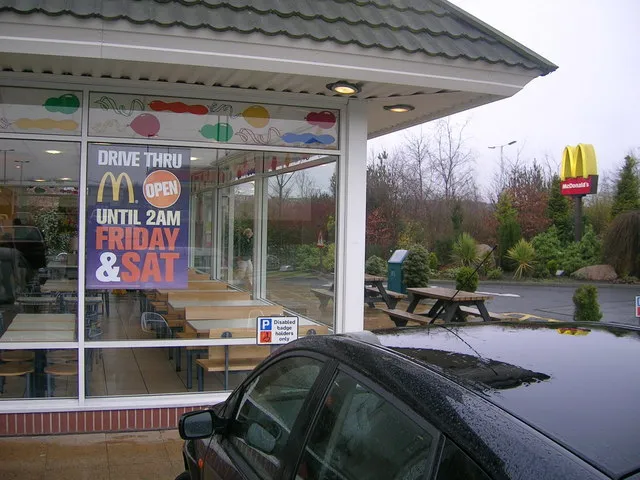
Photo: Ian Thomson, CC BY-SA 2.0, via Wikimedia Commons
There is a specific tone of voice Americans use when ordering food that isn't officially on the menu. It's half an octave lower, slightly hurried, and it carries a very particular satisfaction — the sound of someone using a key they're not entirely sure they're allowed to have.
You can hear it at an In-N-Out in Riverside at 11 p.m. You can hear it in a Starbucks drive-thru in Ohio at 7 a.m. It's the same sound. It's the sound of a password working.
The Original Cipher
In-N-Out is the closest thing this country has to a canonical text. The printed board lists burgers, fries, shakes, and that's more or less it — but the chain's own website has carried a page for years laying out the not-so-secret menu in plain English: animal style, protein style, the 3x3 and 4x4, animal fries, the Flying Dutchman. Two patties, two cheese slices, no bun, no produce.
The genius of it is generational. This knowledge moved person to person for decades before the internet got involved, passed in cars and at lunch tables, and it functioned as a low-stakes initiation rite. Knowing the words meant somebody had bothered to teach you.
That's the thing about a good secret menu item: the item is almost beside the point. The ritual is the product. Ordering off-menu confirms you're not a tourist.
Then TikTok Handed Everyone the Password
Somewhere in the last several years, the whole thing scaled. A single drink video could put a recipe in front of eight million people by lunch. The fan-built Starbucks secret menu — drinks invented by customers, not the company — spread as a set of instructions rather than a set of names, because baristas were never trained on the names. You don't ask for a Cotton Candy Frappuccino. You ask for a vanilla bean Frappuccino with raspberry syrup and hope the person on register is patient.
That distinction matters more than it sounds like it does. A named secret implies an official canon. A recipe implies folklore. Starbucks has been careful, over the years, to stay on the folklore side of that line while quietly promoting the fan creations that work — a few of the customer-invented drinks have crossed over into full menu citizenship, at which point the secret is over and the ritual starts over somewhere else.
What the Apps Did to the Ritual
Mobile ordering broke the whole thing open and rebuilt it as a game.
When you build your own drink in an app, the negotiation disappears. No eye contact, no explaining, no risk that the person at the register says we don't do that. You just stack modifications until the ticket prints and the total climbs. The result is a strange new genre of order: technically legal, structurally absurd, and completely frictionless to place.
Chains noticed. A limited item that only appears in the app, a customization that unlocks at a certain loyalty tier, a one-day drop announced only to people who follow the right account — this is secret-menu logic run in reverse. Instead of customers inventing a password, the brand manufactures one and doles it out. It's exclusivity as a retention feature.
Chipotle wrapping a burrito inside a quesadilla and making it an app-only order was an early, elegant version of this. You weren't in on a secret. You were in a funnel.
The Counter's-Eye View
Any honest accounting of the secret-menu economy has to start at the register, because that's where the bill lands.
Employees describe the same pattern across chains: a viral drink means fifty people ordering it in a week, each one reciting a recipe they saw in a fifteen-second video, each one mildly annoyed that the person taking the order doesn't recognize it. The labor is real. So is the gap between how fun the order feels to place and how it feels to make during a rush.
Some workers lean in and become creators themselves, posting their own builds and their own warnings. Some quietly post the version of the recipe that actually fits in the cup. The employees are, functionally, the sysadmins of this entire culture — holding knowledge the company never formally issued, deciding case by case how much of it to honor.
Manufactured Exclusivity, and How to Tell the Difference
The line between insider knowledge and marketing wearing an insider costume has gotten thin. A few ways to feel for it:
- Who invented it? If the recipe originated with customers and spread without a budget, it's folklore. If it originated in a brand's social team, it's a campaign with a Halloween mask on.
- Does it survive the drive-thru? Folklore travels by voice. If the only way to order something is to show a screenshot, it was built for the screenshot.
- Is there a reason it's off-menu? Genuine off-menu items usually exist because of kitchen constraints, legacy equipment, or worker improvisation. Manufactured ones exist because scarcity converts.
- Does it cost extra? Almost all of them do. The password is rarely free — you're paying for the modifications, and increasingly you're paying for the feeling of having known.
What We're Actually Ordering
Strip away the branding and the video views and what's left is a small, cheap, repeatable mystery. That's a rare thing in 2026. Most of the internet's secrets are enormous and exhausting — leaks, hacks, things you wish you hadn't seen. A secret menu item is a mystery you can resolve in four minutes for under nine dollars, and then tell someone about.
Which is why the format keeps migrating. It shows up in coffee, in burgers, in smoothie chains, in regional drive-ins where the actual secret is that the owner's kid invented a sandwich in 1998 and it never made the board. The content is different everywhere. The structure is identical: somebody knows a thing, somebody else doesn't, and for one transaction the gap between them closes.
That's not really about food. It's about the small thrill of being let in — and the even smaller thrill of getting to be the one who lets the next person in.